Mosquito Lagoon Vs Indian River Lagoon Fishing
Mosquito Lagoon and the Indian River Lagoon are connected parts of the same estuary system, yet they fish differently, fall under different management rules and suit different kinds of trips. Here is how the two compare for an angler based in Orlando.
Short answer
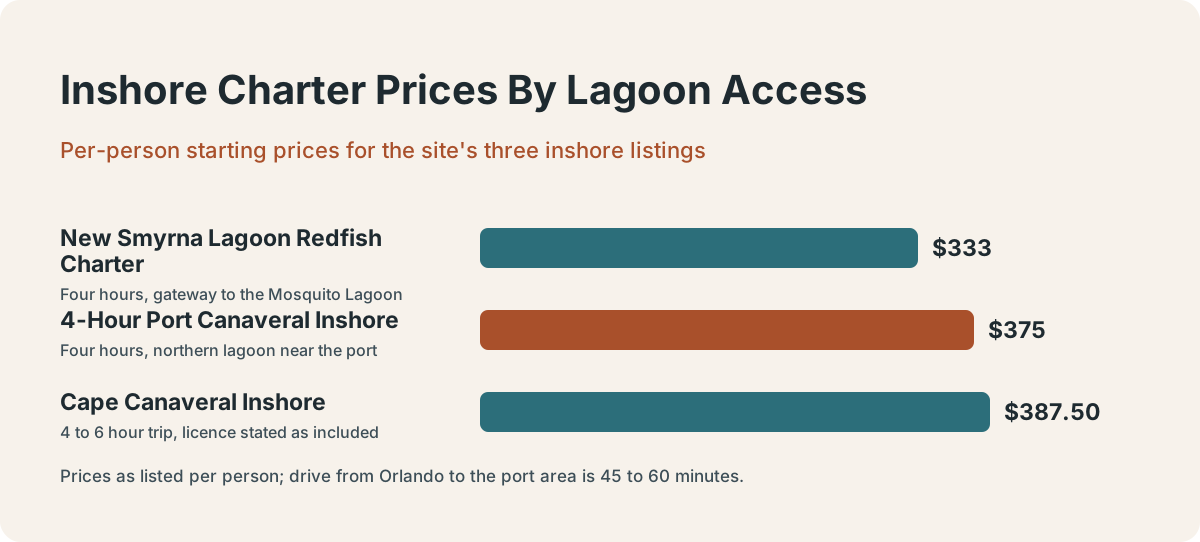
Mosquito Lagoon is the clearer, shallower, more remote northern pocket of the system, famous for sight-fishing redfish on grass flats. The Indian River Lagoon is the broader system to the south, easier to reach from some launch points and richer in variety. Inshore charters from New Smyrna and Port Canaveral cover both, from $333 to $387.50 per person.
Two names, one estuary, and a decision that trips up plenty of visiting anglers. The Mosquito Lagoon and the Indian River Lagoon are physically connected waters on Florida's Space Coast, but they are not the same fishery. The Mosquito Lagoon is the northernmost basin of the wider Indian River Lagoon system, shallow, remote and renowned for sight-fishing big redfish over seagrass. The broader Indian River Lagoon stretches south through Titusville, Cocoa and Melbourne, offering more launch points, more variety and, in some stretches, more fishing pressure.
For an Orlando-based angler comparing inshore charters, the choice matters because the site's own inshore listings fish different ends of this system. The New Smyrna Lagoon Redfish Charter works the lagoon complex near New Smyrna Beach, while the Port Canaveral and Cape Canaveral inshore listings fish from the northern end of the lagoon system near the port. This guide compares the two waters honestly: what lives in each, what the rules allow, what a trip costs and which charter fits which plan. The licence question, by the way, has a clean answer here: a paying passenger on a licensed saltwater charter is exempt from needing their own licence, though it is always worth asking your captain to confirm before the trip.
Which Lagoon Should You Fish From Orlando?
For most Orlando visitors, the choice comes down to drive time and fishing style rather than fish quality. Mosquito Lagoon, about an hour to an hour and a quarter east of the city, rewards anglers who want shallow-water sight fishing for redfish in clear water. The Indian River Lagoon, reached via Titusville, Cocoa or Port Canaveral, offers easier access, more launch options and a wider species mix, including snook, trout and tarpon depending on season.
Both waters sit on the same estuary and both produce quality fish. The practical differences are real though. The Mosquito Lagoon is the most pristine basin in the system, the only one rated "good" overall in the Marine Resources Council's lagoon health report, with seagrass coverage up 54.6 percent between 2021 and 2023. That grass is the engine of the fishery: redfish, trout and black drum hold over it, and in clear conditions you can see the fish before you cast.
The broader Indian River Lagoon gives you more water to work with and more ways to fish it. Docks, channel edges, flats and mangrove shorelines all hold fish, and the system's southern basins have seen some of the strongest recent seagrass recovery, with overall lagoon coverage more than doubling since 2021. If your group wants variety and a shorter, more flexible day, the Indian River side usually wins. If your group wants the classic shallow-water redfish experience, the Mosquito Lagoon is the destination.
What Is The Difference Between Mosquito Lagoon And The Indian River Lagoon?
Mosquito Lagoon is a single shallow basin between Oak Hill and New Smyrna Beach, protected inside a national seashore and famous for sight-fishing redfish on open grass flats. The Indian River Lagoon is the parent estuary, a long stretch of connected water from New Smyrna south past Melbourne, deeper in the channel, more developed along its shores and more varied in habitat. The lagoon is a basin; the Indian River is the whole system.
The naming confuses everyone at first. The Mosquito Lagoon sits at the northern tip of the Indian River Lagoon system, separated from the wider lagoon by a causeway at New Smyrna Beach. Anglers fishing "the Indian River" from Titusville or Cocoa are fishing the same connected water, just the broader central basins rather than the shallow northern pocket.
Habitat is the real dividing line. The Mosquito Lagoon's flats are shallow enough that boats pole across them, and the water clears quickly between tides because there is no inlet nearby to stir in ocean water or sediment. Redfish there grow large and stay shallow year-round, which is why the lagoon carries its reputation as a trophy redfish destination. The Indian River basins hold those same fish but add mangrove shorelines, residential docks and deeper channel drops, which spreads the fish out and spreads out the ways you can catch them.
Access follows the same split. Mosquito Lagoon trips launch from small ramps at Oak Hill or Haulover Canal, genuinely remote spots with no marina infrastructure to speak of. Indian River trips launch from Titusville, Cocoa and the Port Canaveral area, all of which are easier to reach from Orlando via the SR-528 Beachline, typically a 45 to 60 minute drive.
If you are weighing the two as a first-time visitor, the honest framing is this: you are choosing between a wilderness-style shallow-water trip and a more conventional inshore trip with more creature comforts nearby. Both can produce the same fish. Our guide to inshore fishing in Mosquito Lagoon from Orlando goes deeper on the northern option if that is where you are leaning.
Which Inshore Charter Covers Which Lagoon?
The site's three inshore listings split the system geographically. The New Smyrna Lagoon Redfish Charter fishes the lagoon complex around New Smyrna Beach, the gateway to the Mosquito Lagoon, from $333 per person for four hours. The 4-Hour Port Canaveral Inshore charter, from $375 per person, and the Cape Canaveral Inshore charter, from $387.50 per person, fish from the northern lagoon waters near the port.
The New Smyrna listing is the natural pick for the Mosquito Lagoon experience. It is a four-hour trip targeting redfish in the lagoon system near New Smyrna Beach, which puts the boat within reach of the lagoon's famous flats. The listing carries a 5.0 rating from a single review, so treat that figure plainly: one happy customer, not a proven track record. The price is firm at $333 per person.
The Port Canaveral option is the convenience play. A four-hour inshore charter departing the Port Canaveral area at $375 per person, rated 4.0 across 4 reviews, it suits anglers staying near the coast or combining a fishing morning with a cruise or beach day. The drive from Orlando is 45 to 60 minutes on the Beachline.
The Cape Canaveral inshore listing, from $387.50 per person for a 4 to 6 hour trip, is the roster's clearest example of a saltwater trip where the licence is stated as included on the listing itself. With only 3 reviews behind its 5.0 rating, the score is a data point, not a verdict. For a fuller walk-through of the licence rules, see do you need a fishing licence for an Orlando charter.
One thing worth saying plainly: none of these three listings includes hotel pickup, so every trip starts with your own drive to the dock. That makes the departure point a genuine decision factor, not just a line on the map.
What Fish Species Live In Each Lagoon?
Redfish are the headline species in both waters, and in the Indian River Lagoon management region they are catch-and-release only. Mosquito Lagoon is the trophy redfish destination, with big fish common on the flats. The broader Indian River adds snook, spotted seatrout, black drum, tarpon and flounder, with snook seasons open February through May and September through mid-December, and new seatrout rules in force since April 2026.
The redfish rule is the one that surprises visitors most. While most of Florida allows one redfish per harvester within the 18 to 27 inch slot, the Indian River Lagoon region, which includes the Mosquito Lagoon, is catch-and-release only for red drum. That is a conservation measure tied to the estuary's seagrass and water-quality struggles, and it applies to charter trips as much as private boats. You can still catch them, fight them and photograph them; you just cannot keep one.
Snook fishing is where the broader lagoon shines. The IRL management region runs from Lytle Avenue in New Smyrna Beach south to the Martin-Palm Beach county line, with a 28 to 32 inch slot and a one-fish daily bag. Harvest seasons run February 1 through May 31 and September 1 through December 14, with catch-and-release allowed the rest of the year, per the FWC's own season announcements.
Spotted seatrout rules changed in April 2026 and matter here. In the IRL region the recreational bag limit is two fish per person, the slot is 15 to 19 inches, there is no over-slot allowance, and the season runs January 1 through October 31, closed November and December. Anglers used to the more generous northeast-region rules should check the current FWC coastal species regulations before planning a trout dinner.
Species by water, in short:
| Species | Mosquito Lagoon | Broader Indian River Lagoon | Keep rules (IRL region) |
|---|---|---|---|
| Redfish | The marquee fish, trophy class on shallow flats | Common near docks and channel edges | Catch-and-release only |
| Spotted seatrout | Good on deeper grass edges | Strong, especially October through May | 2 per person, 15-19 inches, closed Nov-Dec |
| Snook | Present but not the main target | A highlight, spring and fall peaks | 1 per person, 28-32 inches, seasonal |
| Black drum | Reliable around oyster bars | Common under causeway bridges | Statewide slot rules apply |
| Tarpon | Occasional summer visitor | Summer staple in southern basins | Mostly catch-and-release |
The seagrass recovery story underpins all of this. Lagoon-wide seagrass coverage reached 42,112 acres in 2025 mapping data, up from 19,821 acres in 2021, and the Marine Resources Council's lagoon report rated Mosquito Lagoon the only basin "good" for the second straight year. More grass means more bait, more juvenile habitat and, ultimately, more fish for the flats.
When Is The Best Time To Fish Each Lagoon?
Both lagoons fish year-round, but the prime window runs October through May. October stands out for large redfish schools on the flats, winter concentrates fish near deeper water and warm refuges, and April is the peak snook month in the broader lagoon. Summer is productive early and late but brings heat, afternoon storms and the seatrout season closure in November and December.
Fall is the sweet spot for a first trip. October is repeatedly cited as one of the finest months for big redfish schools on the lagoon flats, and the fish are aggressive after the first cool fronts. A four-hour morning charter in October hits the best tide and light conditions without committing your whole day. Other pages covering the same trip are gathered on Fishing Tours Orlando.
Winter has a specific advantage: cold snaps concentrate fish. When water temperatures drop, redfish and trout stack near deeper holes and sun-warmed flats, which can make for spectacular sight fishing in the Mosquito Lagoon's clear water. The trade-off is weather sensitivity; a hard front can shut things down for a day or two, so keep some schedule flexibility.
Spring brings the snook. April is the peak staging month in the broader lagoon, with fish moving toward passes and feeding hard ahead of the summer migration pattern. Late spring and early summer also open the tarpon window in the southern basins. Summer itself is a dawn-and-dusk game: fish early, get off the water by mid-morning, and expect afternoon thunderstorms.
The seasonal shape of a year on these waters, at a glance:
| Season | Mosquito Lagoon | Broader Indian River Lagoon |
|---|---|---|
| October-November | Big redfish schools on the flats, aggressive feeding | Same redfish push plus gator trout; seatrout season closes November 1 |
| December-February | Clear, cold water concentrates fish; sight fishing at its best | Snook and redfish hold near warm-water spots after cold snaps |
| March-May | Spawn-season redfish, steady trout on grass edges | Peak snook staging in April, open snook harvest season |
| June-September | Early-morning trips beat the heat; tarpon possible | Tarpon in southern basins, snook season reopens September 1 |
For a fuller seasonal breakdown across all of Central Florida's fisheries, see the best time of year to fish near Orlando.
How Much Does A Lagoon Charter Cost And What Is Included?
The site's three inshore lagoon charters run from $333 to $387.50 per person for four to six hours, all private trips with a licensed captain, rods, tackle and bait included in the listing price. No freshwater-style licence purchase is needed on any of them: saltwater charter passengers are covered under the operator's charter licence, though the standard advice is to ask your captain to confirm.
The price band is genuinely narrow, which makes the decision about geography and duration rather than budget. Here is how the three listings compare on the numbers that matter:
| Charter | Departure point | Duration | Price per person | Rating and reviews |
|---|---|---|---|---|
| New Smyrna Lagoon Redfish Charter | New Smyrna Beach | 4 hours | From $333 | 5.0, 1 review |
| 4-Hour Port Canaveral Inshore | Port Canaveral area | 4 hours | From $375 | 4.0, 4 reviews |
| Cape Canaveral Inshore Charter | Cape Canaveral | 4-6 hours | From $387.50 | 5.0, 3 reviews |
Two costs sit outside the charter price. Tipping is customary in Florida at 15 to 20 percent of the charter cost, in cash, with 20 percent the common target for a good day. And if you want to fish the lagoon independently before or after your charter, a non-resident 3-day saltwater licence is $17, the cheapest option for a short visit.
What you get for the money is consistent across the category: a captain who knows the local flats, all tackle and bait, and usually fish cleaning at the dock where regulations allow harvest. What you do not get on any of these listings is hotel pickup; every trip requires you to drive to the departure point. Build the drive into your plan, especially for Mosquito Lagoon trips, where the last stretch to the ramp is slow two-lane road.
How Do You Get To Each Lagoon From Orlando?
Port Canaveral and the northern Indian River launches are the closest saltwater option, typically 45 to 60 minutes from Orlando via the SR-528 Beachline, roughly 45 to 54 miles. New Smyrna Beach and the Mosquito Lagoon ramps are a longer haul, about 90 minutes to two hours of driving depending on traffic, but the highway route is straightforward. Neither trip requires an early start beyond what the fishing demands.
The practical difference is about an hour of driving. For a four-hour charter out of Port Canaveral, you can leave Orlando at 6 a.m. and be on the water on time. For a Mosquito Lagoon trip out of New Smyrna, plan to leave by 5 a.m., or consider staying in Titusville or New Smyrna the night before, which our where to stay for a fishing trip near Orlando guide covers in detail.
Cruise traffic is the one wildcard on the Port Canaveral route. Embarkation mornings can add meaningful time to the Beachline, so check whether your charter date collides with a heavy cruise day. The New Smyrna route avoids that entirely but runs through more suburban lights after you leave the highway.
One honest note on the Mosquito Lagoon's remoteness: the ramps at Oak Hill and Haulover Canal have limited parking and no facilities. That is part of the fishery's charm and part of its friction. Arrive early, bring what you need and treat the drive as the price of fishing one of Florida's clearest inshore waters.
Which One Fits Your Orlando Trip?
Book the New Smyrna Lagoon Redfish Charter if the trophy redfish flats experience is the point of your trip and you can handle the drive. Book the Port Canaveral or Cape Canaveral inshore charters if you want a shorter travel day, a flexible schedule near the coast, or the longest on-paper trip duration at the Cape listing's 4 to 6 hours. All three cover the same licence exemption, so the licence question never decides it.
Think of it as choosing between the destination and the day. The Mosquito Lagoon side is a destination trip: you go there for the fishery, you plan the day around it, and the flats deliver the experience you came for. The Port Canaveral side is a day trip: easy drive, easy schedule, and fishing that is very good even when it is not the lagoon's signature sight-fishing show.
Every detail below comes straight from the live booking pages, so you can compare trip lengths, review counts and cancellation terms before you book. Whichever lagoon you choose, book the captain who fishes it regularly; local knowledge on these flats is worth more than any gear list.
Common Questions About Mosquito Lagoon Vs Indian River Lagoon Fishing
Is Mosquito Lagoon part of the Indian River Lagoon?
Yes. The Mosquito Lagoon is the northernmost basin of the wider Indian River Lagoon system, connected at New Smyrna Beach. Anglers and agencies often treat them separately because the lagoon is shallower, clearer and more remote than the broader lagoon to the south, but they are physically one estuary.
Can you keep redfish from Mosquito Lagoon or the Indian River Lagoon?
No. The Indian River Lagoon management region, which includes the Mosquito Lagoon, is catch-and-release only for redfish, a rule distinct from the statewide 18 to 27 inch slot that applies where harvest is allowed. You can catch, photograph and release them; you cannot harvest one on any charter or private trip in these waters.
Do you need a fishing licence for a lagoon charter?
Not for the saltwater charter itself. A paying passenger on a licensed for-hire vessel is exempt from needing their own saltwater licence under FWC rules, which covers the site's New Smyrna, Port Canaveral and Cape Canaveral inshore listings. The standard advice is to ask your captain to confirm the charter licence before the trip.
Which lagoon is better for beginners?
The Port Canaveral side is usually the gentler introduction: a shorter drive, a conventional inshore trip format and nearby amenities. The Mosquito Lagoon is better for anglers who specifically want the sight-fishing experience and do not mind an early start and a remote launch. Both fisheries produce redfish, trout and black drum for first-timers.
What is the best month to fish the lagoons near Orlando?
October is the standout for large redfish schools on the flats, and the broader October-through-May window is the prime season overall. April is the peak snook month in the Indian River basins. Summer fishing is productive early and late, but November and December bring the spotted seatrout season closure in the IRL region.
How far is Mosquito Lagoon from Orlando?
The Mosquito Lagoon area around New Smyrna Beach and Oak Hill is roughly 90 minutes to two hours of driving from Orlando depending on your starting point and traffic. The Port Canaveral end of the lagoon system is closer, typically 45 to 60 minutes via the SR-528 Beachline.